

For most trade businesses, the van is the single most visible piece of marketing you own. It sits on driveways, outside job sites and in supermarket car parks, and it does that work every day, whether or not anyone is thinking about it.
A website gets visited by people who already know you exist. A van gets seen by everyone who happens to be walking past, which makes it the closest thing a small trade business has to advertising that pays for itself.
The difference between van signage that generates enquiries and van signage that simply looks tidy comes down to a handful of decisions, and most of them are made before anyone touches a roll of vinyl.
Legibility Beats Creativity Every Time
The most common mistake we see is treating the van like a business card. Business cards are read from thirty centimetres away by someone already interested. A van is read from across a car park, or from a car behind you in traffic, by someone with no particular reason to care. Those are completely different design problems.
In practice, this means fewer words, larger type and stronger contrast. A trade name that can be read at forty metres is worth more than a beautifully composed layout that can only be read at four.
Thin decorative fonts, low-contrast colour pairings and long paragraphs of service descriptions all fail the same test: if a driver cannot take it in during a three-second glance at a set of traffic lights, it is not earning its place.
The other thing that consistently gets overloaded is the service list. Trades often want every discipline they cover printed down the side of the van, which produces a wall of small text that nobody reads. Two or three words that describe what you do, applied at a size people can actually see, will outperform a list of fifteen every time.
What Actually Needs to Be on the Van
There are really only four things that have to be there. Your business name, what you do, one way of getting in touch, and any accreditation that carries weight in your trade.
The contact details are worth thinking about carefully. A phone number is still the most effective single option for most trades, because a customer who has just discovered a leak or a dead consumer unit wants to speak to somebody now, not fill in a form.
If your business genuinely wins work through the website, then include the domain, but resist the urge to include the phone number, the website, the email address and four social handles.
Every extra element makes the others smaller.
Accreditations are the exception to the rule of keeping things minimal because, for many customers, they are the deciding factor. A Gas Safe registration number, an NICEIC or NAPIT logo,
TrustMark, CHAS or Federation of Master Builders membership all do real persuasive work.
They answer the question the customer is quietly asking:s whether you are the sort of firm that will do the job properly.
Where the Signage Goes Matters as Much as What It Says
Vans have three surfaces that behave differently, and it is worth spending accordingly.
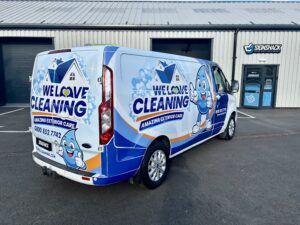
The rear doors are the most valuable part of the vehicle because they are what face stationary traffic. Somebody stuck behind your van at a junction has ten or fifteen seconds to read it, which is far longer than anyone gets from the sides. If the budget only stretches to one panel done properly, make it the back.
The nearside is the surface that pedestrians and homeowners see, since it faces the kerb whenever you are parked up on a job.
That makes it the panel that matters most for picking up neighbouring work, which is how a great deal of domestic trade business actually arrives. The offside is seen mainly by passing traffic at speed, so it wants the simplest treatment of the three.
The bonnet and roof are usually a waste of money for a trade van unless you spend a lot of time in multi-storey car parks or in front of upper-floor windows.
What Works for Each Trade
Builders and groundworkers need signage that survives the conditions. Site access, mud, stone chips and pressure washing take a serious toll, so material choice matters more here than on any other trade van.
A cast vinyl with a laminate will hold up considerably better than a cheaper calendered film, and it is worth keeping graphics off the lowest section of the panels where spray and grit do the most damage. Builders also benefit from showing scale, so a well-branded van that looks like part of a fleet reads as a more established business than one that looks like a sole trader who bought a van last week.
Electricians get more value from accreditation than almost anyone. NICEIC and NAPIT logos are recognised by a large proportion of the public and by every letting agent and landlord you might want to work for, so they deserve proper prominence rather than being tucked into a corner at postage stamp size.
Beyond that, electricians tend to do well with a clear specialism, since “rewires and EV chargers” tells a passer-by something useful in a way that “electrical services” does not.
Plumbers and heating engineers live and die by the phone number, because so much of the work is urgent. Emergency callouts are decided in the time it takes somebody to find a number they can dial, so this is the trade where the number should be the largest element on the van after the business name.
The Gas Safe registration number is not optional in most customers’ eyes, and it should be legible rather than decorative.
Choosing Between Lettering, Part Wrap and Full Wrap
Cut vinyl lettering is the entry point. It applies your name, number and logo directly to the paintwork; it is the least expensive option, and on a white van, it can look extremely sharp. It is also the easiest to update when your number or accreditation changes.
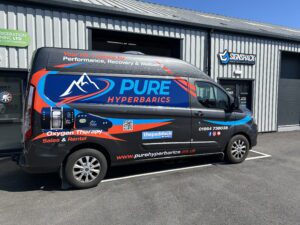
A part wrap adds printed panels to selected areas, usually the lower sides and the rear doors, allowing you to introduce colour, imagery and a stronger brand presence without the cost of covering the whole vehicle. For most trade businesses, this is the sweet spot.
A full wrap covers the entire vehicle and gives you complete control over its appearance, including the ability to change the base colour.
It costs the most and takes the longest, and it makes the most sense when the van itself is a large part of how customers judge you, or when you are running a fleet that needs to look identical.
A Note on Leased and Financed Vans
If the van is on a lease or a contract hire agreement, check the terms before anything is applied. Most agreements permit signage, but they usually require that it be removed professionally at the end of the term and that the paintwork be left undamaged.
Vinyl applied over the manufacturer’s paint and removed correctly rarely causes a problem. Still, heat and time can make removal harder, and a poorly executed job can result in a charge at the end of the agreement.
It is a straightforward conversation to have up front and an expensive one to have later.
Keeping It Looking Right
Good van signage lasts several years, but only if it is looked after. Pressure washers held close to an edge will lift vinyl, and abrasive brushes will dull a printed panel long before it fails.
Washing by hand, keeping the jet away from the edges of graphics and parking out of direct sun where practical, will all extend the life of the work considerably.
It is also worth being honest about the point at which signage stops helping. Faded, peeling or out-of-date graphics say something about your business that you would rather they did not, and a van with the wrong phone number on it is worse than a plain one.
Talk to Signshack About Your Van
We have been producing van signage and vehicle graphics for trade businesses across Hampshire since 2017, working with builders, electricians, plumbers and everyone in between from our base near Portsmouth.
Whether you need simple lettering on a single van or a consistent look across a growing fleet, we can talk you through the options and their costs.
Get in touch to discuss your vehicle and we will put together a design that works as hard as you do.