

Few pieces of signage work as hard for the money as a well-placed pavement sign. Sitting right at the edge of the footpath, an A-board catches people at the exact moment they are deciding whether to walk on or step inside, which makes it one of the most cost-effective ways for a high-street business to turn passing footfall into customers.
But pavement signs are not quite a case of “put one out and forget it.” There are rules about where and how you can display them, and a real difference between a board that pulls people in and one that simply clutters the kerb.
This guide covers the three things that matter most: the rules you need to follow, design ideas that actually work, and the best practices that keep your board safe, legal, and effective.
If you already know what you need and just want a board made, you can head straight to our pavement signs service in Portsmouth. Otherwise, read on.
What Counts as a Pavement Sign?
“Pavement sign” is a catch-all term for the free-standing, movable signs businesses place outside their premises. The most common types include:
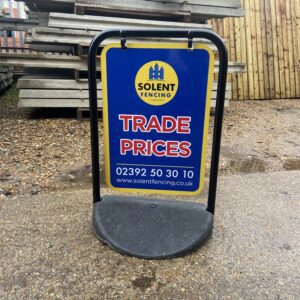
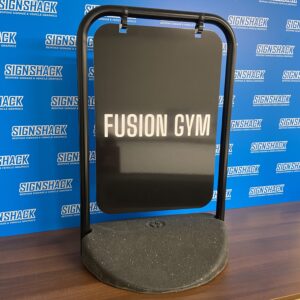
A-boards (also called A-frames or sandwich boards) are the classic two-panel boards hinged at the top, ideal for daily promotions and easy to bring in at the end of the day. Swinging or pendulum pavement signs hold a printed panel in a weighted frame that pivots in the wind, reducing the chance of being blown over.
Forecourt and water-based signs use a heavy, fillable base for stability in exposed spots. Snap-frame boards let you change a printed poster in seconds, while chalkboard A-boards suit cafés and venues that want to rewrite their message by hand each day.
Each style suits a different setting and message. You can see the full range on our pavement signs page, but the right choice usually comes down to where the board will stand, how often you will change the message and how much wind it needs to cope with.
The Rules: What You Can and Can’t Do
This is the part most businesses overlook, and getting it wrong can result in fines or your board being removed. The important thing to understand is that there is no single national law for pavement signs in the UK. Instead, they are governed locally, so the rules depend on your council.
Permission and the Highways Act
If you place a board on the public highway, which includes the footway outside your shop, you generally need permission. Under the Highways Act 1980, wilfully obstructing the highway is an offence, and an A-board left without the right consent can be treated as exactly that.
Advertising boards also require advertising consent under the Town and Country Planning (Control of Advertisements) Regulations 2007.
A common misconception is worth clearing up here: the “pavement licence” many cafés hold for tables and chairs does not cover advertising boards.
That regime, introduced under the Business and Planning Act 2020 and made permanent by the Levelling Up and Regeneration Act 2023, applies only to removable furniture. Your A-board needs separate permission.
The good news is that a board placed on your own land, an enclosed shop forecourt, a café terrace, or a private frontage usually falls under deemed consent, so it tends to raise far fewer issues than one on the public footway.
Penalties
The penalties for getting it wrong are not trivial. Placing an advertising sign on a pavement or road without the correct licence can lead to a fine of up to £2,500, plus a further £250 for every day the sign remains in place. Boards that the council can remove breach licence conditions.
The Rules in Portsmouth
Portsmouth City Council manages A-boards on the public highway through a highway amenity permission, granted under sections 115A to 115K of the Highways Act 1980. Permissions are considered on an individual basis and are generally granted only in areas judged to pose a low obstruction risk and outside the busier “stress areas” the council has identified.
A fee applies (around £209 for a new street display application at the time of writing), permissions typically run for up to 12 months, and the council’s own guidance even specifies design features such as detectable bars at roughly 100mm and 800mm above ground so that visually impaired pedestrians can sense boards.
Because policies and fees change, it is always worth confirming the current position directly with Portsmouth City Council’s licensing team, or checking the GOV.UK pavement and street display licence guidance, before you put a board out. Treat this article as a helpful starting point rather than legal advice, the final word always rests with your local authority.
Best Practice: Placement and Safety
Staying compliant and keeping people safe go hand in hand. A few habits will keep your board on the right side of both.
Leave a clear path. Councils expect enough unobstructed pavement for everyone to pass, and the figures vary by area. Many ask for at least 1.5 to 1.8 metres of clear width, and often a 2-metre gap from tactile paving, crossings and bus stops. The needs of wheelchair users, pushchairs, and visually impaired pedestrians should always come first.
Sort out insurance. Most councils require public liability insurance, commonly to the value of £5 million, before they will grant permission. It protects you if your board injures someone.
Plan for the weather. Portsmouth is a coastal city, and a lightweight board on a windy seafront day is an accident waiting to happen. Choose a design with a low centre of gravity or a weighted, water-fillable base, and bring the board in when conditions are rough.
Take it in when you close. Many permissions only allow boards to be displayed during trading hours, so make bringing them inside part of your daily routine.
Keep it smart. A faded, chipped, or grubby board reflects badly on your business and can fall foul of council guidelines requiring signs to be professionally produced and well-maintained
Design Ideas That Actually Pull People In
A compliant board still has to earn its keep. The best pavement signs share a few qualities.
Lead with one clear message. The single biggest mistake is cramming in too much. A passer-by gives your board a second or two at most, so pick one idea, today’s special, a key offer, a single strong reason to come in, and make it unmissable.
Make it readable at a glance. Use large, bold type with strong contrast between text and background. If someone has to slow down and squint, the moment has passed.
Stay on brand. Your A-board should feel like part of the same family as your fascia and window display, using the same colours, fonts and logo. Consistency from the street to the door builds trust and recognition.
Use the format to your advantage. A chalkboard invites a friendly, handwritten daily message and suits cafés and independents. A snap-frame makes it effortless to swap in a fresh printed poster, which is perfect for rotating seasonal campaigns, January sales, Valentine’s, Easter, summer and Christmas, all give you a reason to refresh the message and a reason for regulars to look again.
Think about direction. If your entrance is set back, down a side street or above ground level, a pavement sign doubles as a wayfinder, guiding people the last few steps to your door.

How Pavement Signs Fit Your Wider Signage
A pavement sign rarely works alone. It is the final nudge in a sequence that starts further down the street, and it works best as part of a joined-up storefront.
Your shop signage, the fascia, and any hanging or projecting signs do the long-range work of identifying your business from a distance. Window graphics reinforce your brand and offer a close-up.
The pavement sign then closes the deal at the threshold. When all three carry consistent branding, the effect is far greater than any single element on its own.
For businesses that want to go further, pavement signs sit within a broader family of outdoor signage, from banners and flags for events and promotions through to wall and building signs.
Planning these together, rather than piecemeal, gives your premises a polished, cohesive presence that looks deliberate and professional.
Frequently Asked Questions
Do I need a licence to put an A-board outside my shop?
If the board sits on the public pavement, you almost certainly need permission from your council, and there may be a fee. On your own private forecourt or terrace, you generally have more freedom. Rules vary by area, so always check with your local authority first.
A-Boards And Pavement Signs
Yes, pavement signs are legal, but their use is controlled locally rather than by a single national law. As long as you have the right permissions and follow your council’s conditions regarding size, placement, and safety, you are fine.
How big can a pavement sign be?
There is no universal size limit; councils set their own maximum dimensions and often specify how much clear pavement must be left for pedestrians. Check the limits that apply in your area before ordering.
Can I leave my A-board out overnight?
Often not. Many permissions require boards to be displayed only during trading hours and brought inside when you close, both for safety and to keep the pavement clear.
Do I need insurance for a pavement sign?
Usually yes. Councils commonly require public liability insurance, often to the value of £5 million, before granting permission, in case your board injures someone.
Get a Pavement Sign That Works for Your Business
A great pavement sign is equal parts compliance and craft: positioned correctly, built to handle the weather, and designed to make one clear, on-brand impression on everyone who walks past.
Get those right, and an A-board will quietly bring people through your door every single day.
If you are ready to add a pavement sign to your storefront, explore our pavement signs in Portsmouth or get in touch with our team for friendly advice on the right board for your premises and how to integrate it into a signage setup that works from the street to the door.